

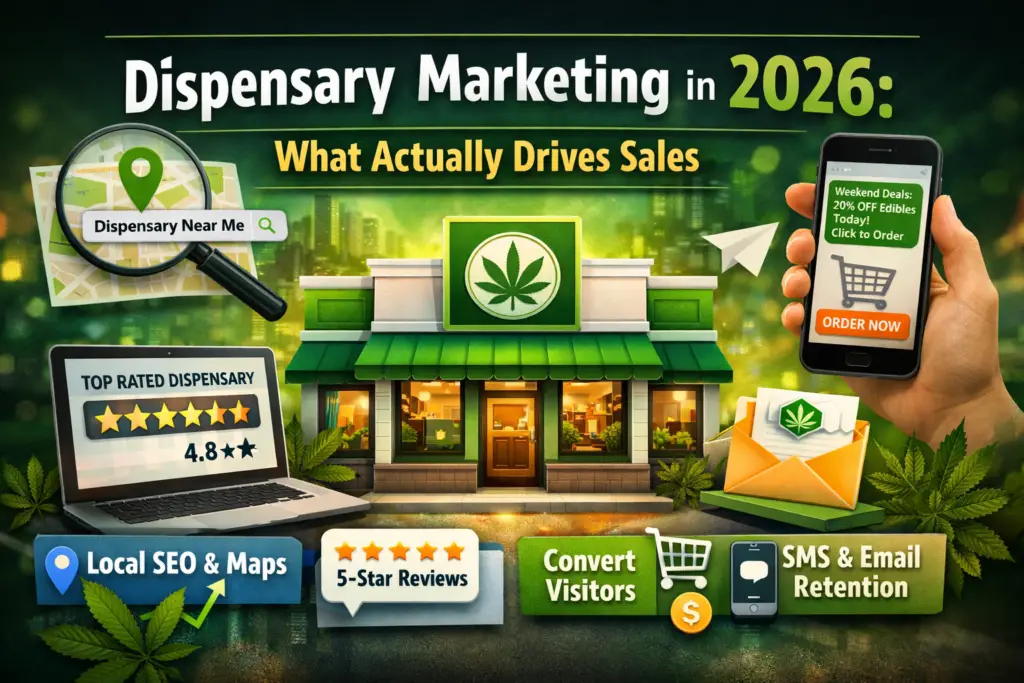
Dispensary Marketing in 2026: What Actually Drives Sales
In 2026, dispensary marketing is less about “going viral” and more about building a predictable system that turns local demand into consistent daily revenue. The dispensaries winning right now are doing three things extremely well:
- they own local search,
- they convert traffic into orders + visits, and
- they retain customers with smart lifecycle marketing.
The twist: because cannabis is still heavily restricted on major ad platforms, the best growth strategy is usually non-paid, high-intent marketing—executed with discipline.
Below is what actually drives dispensary sales in 2026, and how to implement it.
1) Local Search Visibility Is the #1 Sales Driver
Most dispensary purchases start with a local intent search: “dispensary near me,” “best dispensary in [city],” “open now,” “deals,” “vape carts,” etc. If you’re not showing in the top results, you’re voluntarily giving revenue to competitors.
Your goal is simple: be easy to find when someone is ready to buy.
The Local Visibility Stack
- A fully optimized Google Business Profile (GBP)
- Accurate citations (NAP consistency: Name/Address/Phone)
- High-quality photos + categories + services
- Fresh updates (posts, specials—carefully)
- Reviews volume + velocity + responses
- A fast website that matches search intent (menu, deals, location, hours)
Google’s own guidelines for Business Profiles are strict about what you can include in certain fields (for example, business descriptions shouldn’t include links or promotional/price-heavy language). Use the rules to your advantage: keep your profile clean, accurate, and trustworthy.
Outbound support link: Google Business Profile business guidelines
What to do this week
- Audit your GBP name, categories, hours, and attributes for accuracy.
- Add fresh photos weekly (storefront, interior, staff, product displays, signage).
- Create a review request flow (text/email + QR code at checkout).
- Build/refresh location pages on your site (unique content per location).
2) Reviews and Reputation Create the “Trust Trigger”
In competitive markets, customers often choose the dispensary that “feels safest” and most established—especially first-timers. Reviews are that trust signal.
BrightLocal’s ongoing consumer review research consistently shows how heavily people rely on reviews for local business decisions.
Outbound support link: BrightLocal Local Consumer Review Survey (2025)
A review system that drives sales (without being cheesy)
- Ask every happy customer, every day (in-person + text follow-up).
- Make it frictionless: QR code at checkout + short link on receipts.
- Respond to every review (yes, even the short ones).
- For negative reviews: respond calmly, invite them back, and move it offline.
Pro tip: Don’t just chase 5 stars—chase detail. “Friendly budtenders, fast checkout, great selection” sells better than “Great place!”
3) Your Website Must Convert, Not Just “Look Good”
A pretty dispensary site that doesn’t drive actions is a brochure. In 2026, your website’s job is to do one of two things:
- Get the order (online ordering / reserve pickup), or
- Get the visit (directions, call, hours, deals, first-time info)
High-converting dispensary site essentials
- Mobile-first speed (most local traffic is mobile)
- One-tap buttons: Call, Directions, Order Online
- Clear “first-time customer” section (IDs, rules, what to expect)
- Dedicated pages for high-intent searches:
- Deals / daily specials
- “Best sellers” / top categories
- Brand pages (if allowed in your state/site strategy)
- “Open now” / hours prominently displayed
A conversion quick win: put your deal highlights above the fold (without spamming). Make it easy to understand in 5 seconds.
4) Stop Relying on Paid Ads—Build Demand Where It’s Allowed
Most dispensaries learn the hard way: paid advertising options are limited and risky. That doesn’t mean you can’t grow—it means you should build a strategy around channels that reliably work inside restrictions.
- Local SEO (Maps + organic search)
- Email + SMS (retention + promotions to your own list)
- In-store capture (loyalty + subscriber growth)
- Community + partnerships (events, cross-promos, local organizations)
- Organic social (education + culture + brand storytelling)
Google Ads has clear restrictions around recreational drugs-related advertising.
Outbound support link: Google Ads policy: Recreational drugs
Meta also restricts cannabis and cannabis-derived products ads, and requires authorization in limited CBD-related scenarios in some cases—so always confirm what’s currently permitted for your exact product category and region.
Outbound support link: Meta policy: Cannabis & cannabis-derived products
Important: Don’t try to “outsmart” platform policies. Build a compliance-first strategy that lasts.
5) Retention Is Where the Profit Lives (SMS + Email + Loyalty)
New customer acquisition is great—but dispensaries scale faster when they increase:
- repeat purchase rate,
- visit frequency,
- average order value,
- and lifetime value.
What retention looks like in 2026
SMS:
- restock reminders (“Your favorite gummies are back”)
- weekly deal drop (“Weekend specials are live”)
- event pushes (“Vendor day Friday 4–7pm”)
Email:
- new arrivals and best sellers
- education (terpenes, effects, dosing basics—state-compliant)
- loyalty status and personalized offers
Loyalty:
- points + tier perks
- birthday rewards
- VIP early access to drops
Retention works best when it’s segmented:
- first-time customers
- value shoppers
- concentrate lovers
- edible buyers
- medical vs adult-use (if applicable)
Your goal is to stop sending “generic blasts” and start sending messages that feel personal.
6) Merchandising + Offers That Don’t Destroy Margin
“Discount everything” is not a strategy. In 2026, the best dispensaries use offers to shape behavior:
- First-time offer that moves someone into loyalty
- Bundle offers that increase basket size (e.g., “2 carts + battery”)
- Slow-mover promos (protecting premium SKUs)
- Time-based offers (happy hour / early week lift)
A strong offer answers: Who is this for? What do they do next? Why now?
7) Track What Actually Produces Revenue
If you can’t measure it, you can’t scale it.
At minimum, track:
- GBP insights (calls, directions, website clicks)
- Website conversions (calls, clicks, order button taps)
- Top landing pages (which pages bring buyers)
- Call tracking (source + outcome)
- Email/SMS revenue attribution (basic is fine)
The winners in 2026 don’t just “market”—they run a growth dashboard.
The Bottom Line
Dispensary marketing in 2026 is a system:
- Local visibility brings ready-to-buy customers.
- Trust signals (reviews + reputation) make them choose you.
- Conversion turns traffic into orders and visits.
- Retention turns one-time buyers into loyal regulars.
If you build those four pillars, sales becomes predictable—even in restricted ad environments.
Grow Your Cannabis Company Today!
Let’s take your business to the next level—connect with us today.